A single cell, with no nervous system, navigates, remembers, and solves problems it has never met. That was happening for billions of years before the first transformer, which means intelligence is older than brains and older than silicon. If it predates both, it is a property of the right substrate rather than the right architecture, and the interesting question stops being how to build it and becomes what lets it take hold.
That is the lab's whole premise, and it cuts against the grain of a field that treats intelligence as an engineering achievement. We treat it as a natural phenomenon we are learning to read, first in cells, where it has always lived, then in the machines we hope to host it on.
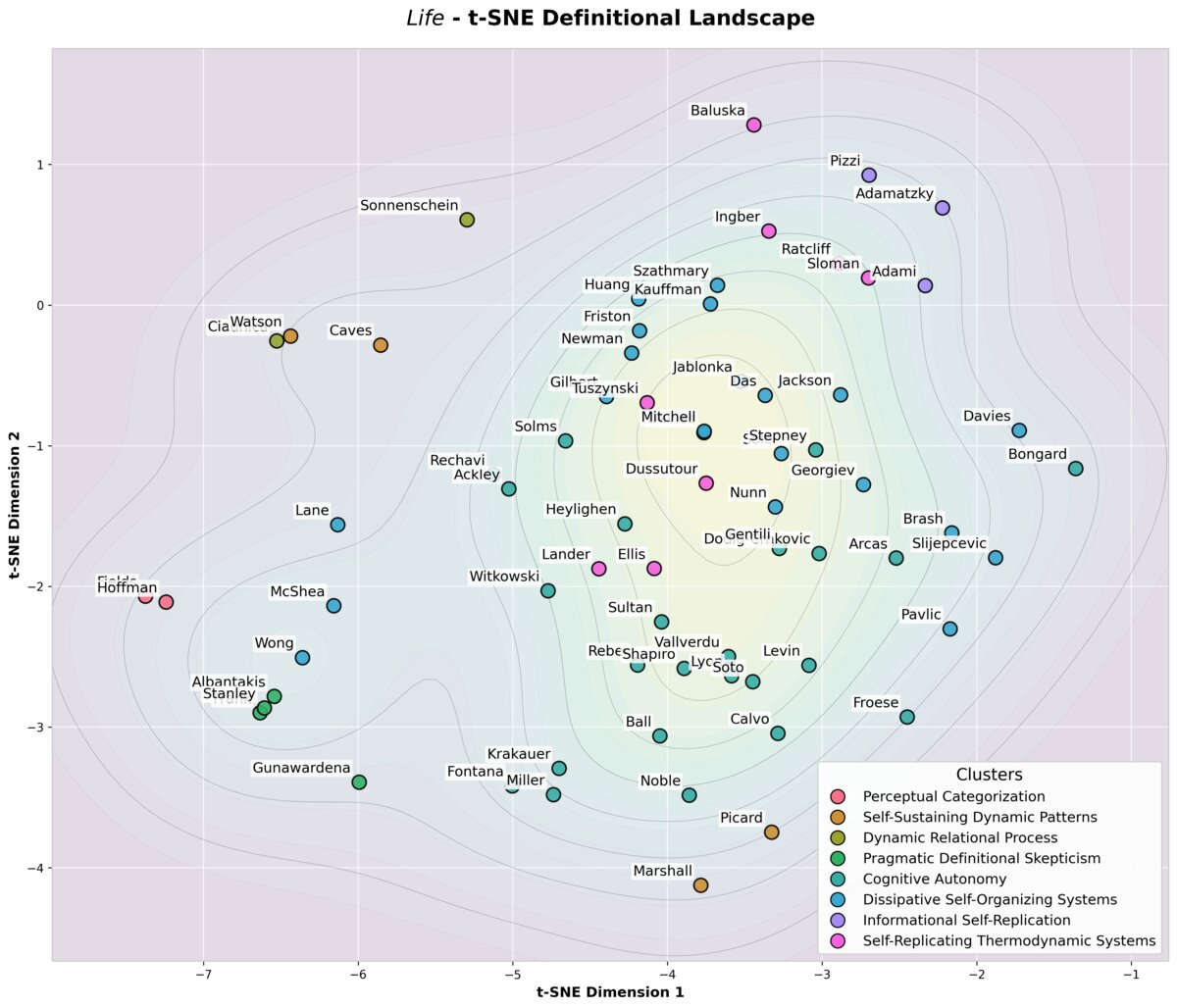
What Lives? A meta-analysis of diverse opinions on the definition of life
We collected 68 expert definitions of life and mapped them into a shared conceptual space, turning decades of disagreement into data. What emerges is a structured landscape: life is a region, not a point.
Read the paperA definition you cannot measure is an opinion, and the field had dozens of them. Embedding the definitions turned that standoff into a geometry: positions with neighbours, distances, and structure. Two axes fell out of the map on their own, observer-dependent against objective and process against substance, the same tensions that have split thinking about life since the Greeks. Nobody encoded them; the representation surfaced them. That move, taking a question everyone argues about and giving it coordinates, is the one that underwrites the engineering too. Get the representation right and the disagreement becomes tractable.
What's next
The next paper stays with self-organisation, this time in a system simple enough to see all the way through: a sorting array running two rules at once, where the elements separate by which rule they follow with no author placing the signal and no observer able to read it. Structure that organises itself with nobody to embed it is a small, clean model of the larger claim, that intelligence is something a substrate gives rise to rather than something a designer puts there. The simulator and analysis are built; the runs come next, and the paper follows the work.